The Ibanez SRMS725
Updated: Aug 18
Reviewing the SR Workshop Ibanez SRMS725
Overview
This review and demo are geared toward the metal bass player. The review also leans more towards the bass player who's never played or owned a multi-scale bass but is curious as to what they're all about, especially in the context of other Ibanez basses. I demonstrate the tones available with the SRMS725, go over the specs, the pros, the cons, the in-betweens, and conclude with my view of where the value lies in this particular Ibanez SR.
Let's get things going with a little bit about me, the reviewer...
To 5-String or Not To 5-String
This is my first 5-string. I'm late to the game with extended range basses, but I've never had an interest in one. Most of what I play doesn't require a 5-string, and the things that do, I can play on a modified 4. Heck, before getting the Ibanez SRMS725, my only experience with a 5 was at a music shop a few years back. That experience, as it turns out, would shape the way I look at the SRMS725 and the role it plays in Ibanez's bass lineup. Anyway, back to my 5-string avoidance for just a moment.
I was introduced and raised on a 4-string. Fives weren't nearly as common in the 1980s (long live the '80s!). Most shops back then were well-stocked with 4s with limited, if any, 5s. Honestly, I can't remember ever seeing a 5 at any of my local music stores. I'm sure they were there as the decade progressed, but I don't recall any. Plus, if you did happen to find a model you liked, they were pretty expensive. For me, it was all about the four.
However, I've wanted a 5 for a while now. Enter the Ibanez SRMS725.
SRMS725 Demo
For the demo, I focused on who I think the main target audience is for the SRMS725: metal bass players. I also focused on the different sounds of the bass in its various configurations, with and without amps/effects. It's less performance and more about the repetition of notes to showcase the SRMS725's tonal capabilities.
A Metal 5-String SoundGear
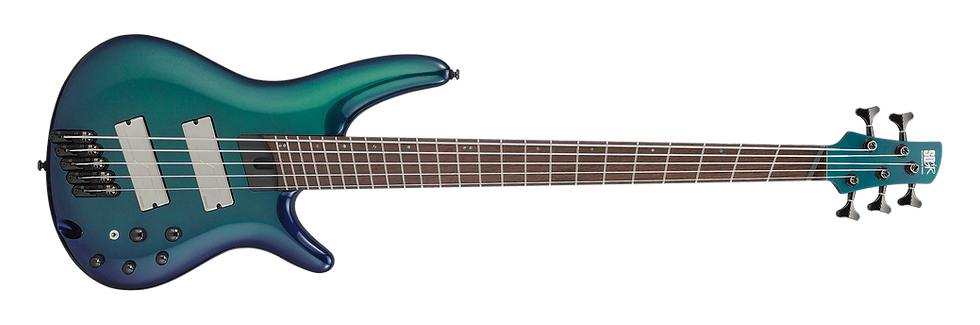
The biggest draw for me for this 5-string was that it was an Ibanez SoundGear (or SR if you prefer). I'm a certified SoundGear aficionado. So, when Ibanez introduced this bass back in 2024, I was intrigued. It definitely screamed metal, with its metallic-blueish-green color, high-gloss finish, black hardware, and the silver, high-tech looking Fishman pickups. The multi-scale neck, though a sound concept on paper, wasn't something I was ever particularly interested in. I just didn't know if I'd like the fanned frets. But I was interested in everything else about the bass. Let's break it down.
Component | Details |
|---|---|
neck type | SRMS5 for Multi Scale / 5pc Maple/Walnut neck |
neck joint | bolt-on |
top/back/body | Okoume (a lightweight, low‑density African hardwood) |
fretboard | Panga Panga fretboard / Off-set white dot inlay (Panga Panga is a very dark, dense, and extremely durable African hardwood) |
fret | Medium frets |
number of frets | 24 |
bridge | MR5S bridge (adjustable saddles for variable string spacing by +/- 1.5mm) |
factory string spacing | 16.5mm |
neck pickup | Fishman® Fluence™ neck pickup |
bridge pickup | Fishman® Fluence™ bridge pickup |
equalizer | Fishman® 3-band EQ w/Single Coil Mode switch (push/pull), 3-way Voice Select switch |
I'm including the neck dimensions of two other Ibanez 5-strings, the SR1325SB and SR505N for comparison. It's a key differentiation point given the SR's legacy of fast, approachable necks.
Neck | SRMS725 | SR1325SB | SR505N |
|---|---|---|---|
Line | Workshop | Premium | Standard |
Family | SRMS for Multi Scale | Atlas* | SR5 |
Scale | 901.7mm/35.5" - 864.0mm/34.0" | 864mm/34" | 864mm/34" |
Width at nut | 45mm | 45mm | 45mm |
Width at 24th fret | 68mm | 68mm | 68mm |
Thickness at 1st fret | 19.5mm | 19.5mm | 19.5mm |
Thickness at 12th fret | 23mm | 21.5mm | 21.5mm |
Radius | 305mm | 305mm | 305 |
*Even though the Premium and Standard lines have the same neck dimensions, the Atlas family of necks have thicker shoulders which result in a more robust neck.
Troubled Start with this Ibanez
To be clear, this bass is not a review unit, opened box/demo bass, or used instrument. I purchased this bass new in March of 2026 from a well-known online retailer.
There were two issues with this bass that I experienced right away. One was an easy fix. The other was worrisome. Let's look at the bigger issue, first.
Wiring Gone Wrong
When I first took the bass out and plugged it in, I was greeted with...nothing. Nada. Zip. After checking my cables, rebooting, and doing everything else one would do, the culprit ended up being a drained battery. I thought that was a little odd since I've never had any bass arrive with a dead battery. OK, things happen. I replaced it with a battery from one of my other basses that I predominantly played in passive mode. That drained out in about a day. Maybe that battery was already low on gas. I plugged in a new, out-of-the-package battery. Three days later, and with only a few of hours of play in an otherwise unplugged state, dead battery.
I researched what it could be, and everything pointed to a wiring issue. I downloaded the Fluence pickup wiring guides from the Fishman site (thank you, Fishman) and realized the battery ground wire was, indeed, incorrectly soldered to the treble pot. It needed to be soldered to the ring lug of the input jack to turn off the battery when the cable is removed and turned on when a cable is inserted. If the circuit isn't broken, say hello to a dead battery in a few short days.

Even though I had little experience soldering, having done it only one other time, I decided to give it a shot, warranty be damned. I didn't like the idea of shipping a brand-new bass back...somewhere or dropping it off at one of my local guitar shops.
After nervously getting a decent joint, I let the bass sit for 24 hours and then tested the voltage. No change. No drain. Kept the cable in for a few days and tested again and had a normal and expected level of battery drain (minimal). Whew! Bass has been fine ever since.
Now, this was an issue from the Ibanez factory, not the retailer. I'm still surprised the QA process didn't catch it before leaving the factory floor. Not like the model is brand new; it's been in production for several years now. And not that any new bass or guitar should have an issue like this, at a price point of around $1,500USD, and never having an issue with a new Ibanez bass before, I was pretty surprised. Anyway, problem solved. On to the next hiccup.
Fishman Fluence Pickups, Hot & Loud
I prefer a passive bass nowadays. I do like active pickups/preamps (and love the ability to switch between the two like you can with many SoundGear Premium basses), but man, those Fishman Fluence pickups run loud and they run hot!
The first thing I noticed when I started playing the bass was the presence of some distortion. Perhaps it was my cab sim. Turned it off. Distortion still present. I checked for anything in my chain that could cause the issue and rebooted, but the problem persisted. Maybe it was my DAW. Checked for updates, rebooted again, started a new project, and still had distortion. Finally, I plugged the bass into a physical amp. Nope, still had distortion. What the heck was going on?
After a quick search, turns out it's a known issue with the Fluence pickups/preamp. At least on the SRMS725. This bass has a custom Ibanez version of the pickups. (It's also the first Fluence pickups for bass to have stainless steel covers. Very cool looking. But I digress.) I had to lower the pickups pretty far, almost as far as they would go, to reduce the output. This eliminated any trace of distortion.
Side note: I don't know why, but a lot of SoundGear pickups are set way too high. Unless you're a really dainty finger-style or pick player, they're probably going to get in the way. I usually have to lower mine as a first order of business with any new SR I get my hands on.
Single Coil Mode with a Simple Pull of the Knob
I do want to highlight the SRMS725's push/pull volume knob. It's a very nice feature that provides a quick and convenient way to instantly change the sound of the bass. Pulling the volume knob switches the pickups to Single Coil Mode. The volume and output are noticeably reduced compared to the default Humbucker configuration and, according to the Fishman site, "adds [a] Jazz Bass string window." (The third section of the demo video switches back and forth between the two pickup modes.)
Overall Feel and Playability of the SRMS725
Playability, appearance, and sound are all subjective. This is my opinion of those things based on what I'm looking for in a bass. Even though your mileage may vary, there are some key items to think about before getting this multi-scale.
What I like about the Ibanez SRMS725:
Pros | Description |
|---|---|
Design | I'm a big fan of the SR design from headstock to body. |
Color/finish | Striking metallic blue/green color depending on how the light hits it (but seems mostly green to me...except when it's in a video). This bass definitely lives up to its name. A high gloss finish compliments the metallic color and adds to the aesthetic and style of a modern, metal instrument. I'd actually like to see more Premiums with a high gloss finish.   |
Pickups/preamp | Even though I have an issue with the pickups, as you'll see below, they offer a lot of flexibility in helping you dial-in a range of tones (listen to the demo video above). |
Low B | Very tight low B string without any flop. |
Bridge | I'm a fan of the Ibanez mono-rail bridges and although the SRMS725 comes with the "S" version, I've yet to move the saddles one way or the other. But I like having the option. For those not aware, the "S" version of the mono-rail bridges allows you to adjust the bass' string spacing by plus or minus 1.5mm. Nice feature for those who want more room between strings for slapping or less room for technical shenanigans. |
Weight | With an Okomue body, the bass isn't going to be heavy. You'll typically find weight ranges between the upper 7lbs to a little less than 8.5lbs. Mine is a comfortable 8lbs 5oz. |
Price/value | At around $1,500USD, it's an affordable mid-tier 5-string. |
What I'm indifferent about:
Meh | Description |
|---|---|
Painted neck | The back of the neck is smooth, but the solid black paint, which is a little uneven in places, gives the bass a bit of a synthetic/industrial look. Reminds me of the Steinberger basses of the 1980s or my own '87 Ibanez SR 800LE (minus the high gloss). The neck does match the rest of the bass' vibe and aesthetics, but...I can take it or leave it. Playability not affected.  |
RATIO® Machine Heads by Graph Tech® Guitar Labs | The tuners are your traditional Gotoh style tuners. But these machine heads by Graph Tech provide "each string with its own specific gear ratio." The Ibanez product page goes on to say, "...once you know what it feels like to tune one string, you will know what it will feel like to tune the rest of the strings." What does that even mean? I don't know, but the tuners do what they need to do. They tune.  |
Toggle Switch | OK, this is going to seem petty and ridiculous, but I'm really not a fan of the Voice Selector switch. The SR Premium line started with this exact same toggle back in 2011, though in a black variant. Ibanez ditched it a few years later. The toggle switch on the SRMS725 feels flimsy and cheap. Plus, the tab on the washer sticks out, adding to the overall cheap look of the thing. The toggle works as advertised, of course, and the chrome fits in nicely with the rest of the instrument's styling, but it seems out of place on a bass that costs around $1,500USD.  |
What I'm not a fan of:


My Biggest Complaint about the SRMS725
This is a direct result of my guitar shop experience playing that other 5-string and I can sum it up like this...
The Ibanez SoundGear SRMS725 is not an Ibanez SoundGear. It's a Dingwall in SR clothing.
That 5-string I played in the music shop? Yep, it was a Dingwall. I don't remember the exact model, but it was a Dingwall 5-string. Fanned frets, slanted pickups, loud and hot, chunky neck.
The SRMS725 feels and plays very much like that Dingwall. You have, of course, the multi-scale neck and its fanned frets. Probably its biggest and most distinguishing feature. The neck is also a little on the chunky side, especially compared to other SR 5-strings. And the pickups are very hot and very loud. Again, not your typical SR-type pickup.
The body is decisively SR, but the playability, pickups/preamp, and overall feel is not.
(Before anyone has a conniption, Dingwalls are fine instruments. They're just not for me.)
Final Thoughts
Do I dislike the Ibanez SRMS725? No, not at all. It's a nice looking, unique instrument that serves a particular style of play and music while also offering a flexible palette of tones. This uniqueness isn't lost on Ibanez, either. The SRMS725 is part of the company's SR Workshop line, an experimental line of basses. The sentiment is reinforced with the Ibanez statement that the instruments "...may not be for everyone."
Even though it doesn't have the heart of an SR, the Ibanez SRMS725 is a solid 5-string with the ability to sculpt a range of tones, especially useful in many styles of metal.
That's my review of the Ibanez SRMS725 with a demo of the various tones you're able to dial-in. I'll update this article if anything changes or I somehow convert to a multi-scale bass player.
Until then, love life and relive the '80s!
DD
Do you play or have you played an Ibanez SRMS725? Do you want to tell other bass players about it? If so, share your experience with me and I'll post it here, along with a response from me, so others can benefit. Use the form on the Home page to get in touch.
Comments